– · Online
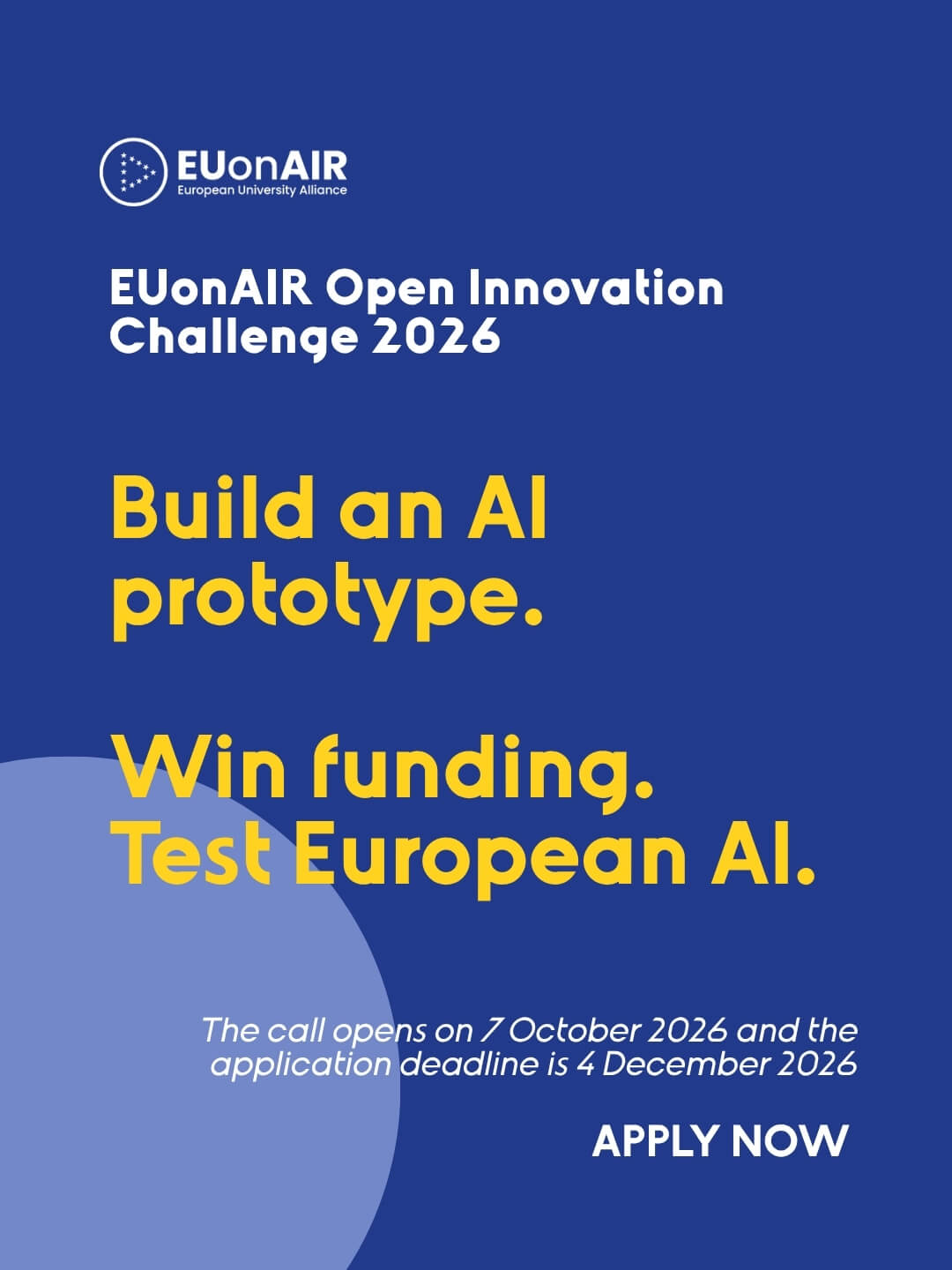
Open Innovation Challenge 2026
EUonAIR Open Innovation Challenge 2026 — Sovereign by Design: Building with Open European Language Models
Compete to build a working AI prototype with an open European language model at its core—apply to win mentoring, EUonAIR-wide visibility, and micro-funding for up to three team projects.
For funded Teams: What you get
- Funding: up to €1,500 (gross / pre-taxes) to be divided among the selected projects, subject to available budget
- Duration: up to 6 months of support
- Mentoring & coaching from EUonAIR experts, including the partner institution that proposed your use case
- Access to infrastructure at consortium partners
- Visibility & networking (showcase, comms channels)
Theme & use cases
- 2026 theme: Sovereign by Design: Building with Open European Language Models
- An openly available European language model (e.g., Apertus, Teuken, EuroLLM, Salamandra) must be central to each prototype rather than decorative.
- The theme spans four directions:
- Multilingual equity: tasks where performing well across the alliance’s languages, including smaller and under-resourced ones, is the actual point.
- Transparency in use: applications that exploit openness itself, such as tracing data provenance, inspecting model internals, auditing behaviour, or producing documentation relevant to the AI Act.
- Sovereign deployment: settings where sensitive data cannot leave European or institutional infrastructure, such as student records, health data, municipal administration, or industrial documentation.
- Research pathway: pilots deliberately scoped to seed a named Horizon Europe or national research proposal.
- Use cases (three in this edition):
- Script forcing for EU language scripts (proposed by SUPSI)
- Testing Grid for Multilingual Equity in Open European Language Models (proposed by SUPSI)
- Explainable Fraud Detection with Open European LLMs (proposed by ZSEM)
Who can apply
- Teams of 2–5 people.
- All members must be affiliated with an EUonAIR partner institution: students (BA/MA/PhD), recent graduates, researchers/postdocs/teaching staff, or practitioners.
- Interdisciplinary teams are strongly encouraged (mix STEM + social sciences/humanities).
- An individual can be funded once per edition.
Key dates (CET)
- 7 Oct 2026 — Call opens
- 4 Dec 2026, 12:00 CET — Application deadline
- 7 – 18 Dec 2026 — Jury evaluation
- 22 Dec 2026 — Funded projects announced
- Jan 2027 — Funding and mentoring start
- 25 Feb 2027 — Interim presentations
- 25 Jun 2027 — Project completion and final presentations
How to apply
- Form a team of 2–5 eligible members.
- Choose one of the published use cases and an open European language model to build on.
- Download the Project Application template.
- Submit the finalized Project Application using the Project Application Form.
What we’re looking for (selection criteria)
- Innovation & impact
- Originality
- Relevance
- Feasibility
What funded teams commit to
- Milestones & monthly mentor check-ins
- Interim presentation and Final Presentation
- Final Report within six weeks after programme end
- Acknowledgement of EUonAIR support on team channels
Rules & documents
- Terms of Participation of the EUonAIR Funding Programme “EUonAIR Challenge”
- Regulations of the EUonAIR Award for EUonAIR Challenge
- EUonAIR Award Agreement
- Use cases
- Project Application template (incl. scoring scale and table)
Deadline for applications
Ready to find out what open European language models can do? Apply by 4 December 2026, 12:00 CET. - https://docs.google.com/forms/d/e/1FAIpQLSd44_bQZlqc46syjq9Seq4v7mUjyU0zqAnP0uuG3IsgFUTwZg/viewform
2026 EUonAIR PC committee
SUPSI: Matteo Casserini & Andrea Ferrario
PJAIT: Adam Wierzbicki (head of the PC committee)
KU: Aleksandra Przegalińska & Konrad Sowa
HTWB: Ricardo Knauer & Martin Roddewig
ISM: Simonas Cepenas
ZSEM: Karmela Aleksić Maslać
HS-HEILBRONN: Carsten Lanquillon
ESSCA: Paul Nathan