What does it take for student participation in university governance to move beyond symbolic representation toward genuine co-decision-making?
Student Co-Decision-Making in University Governance: EUonAIR Presents an Innovative Model
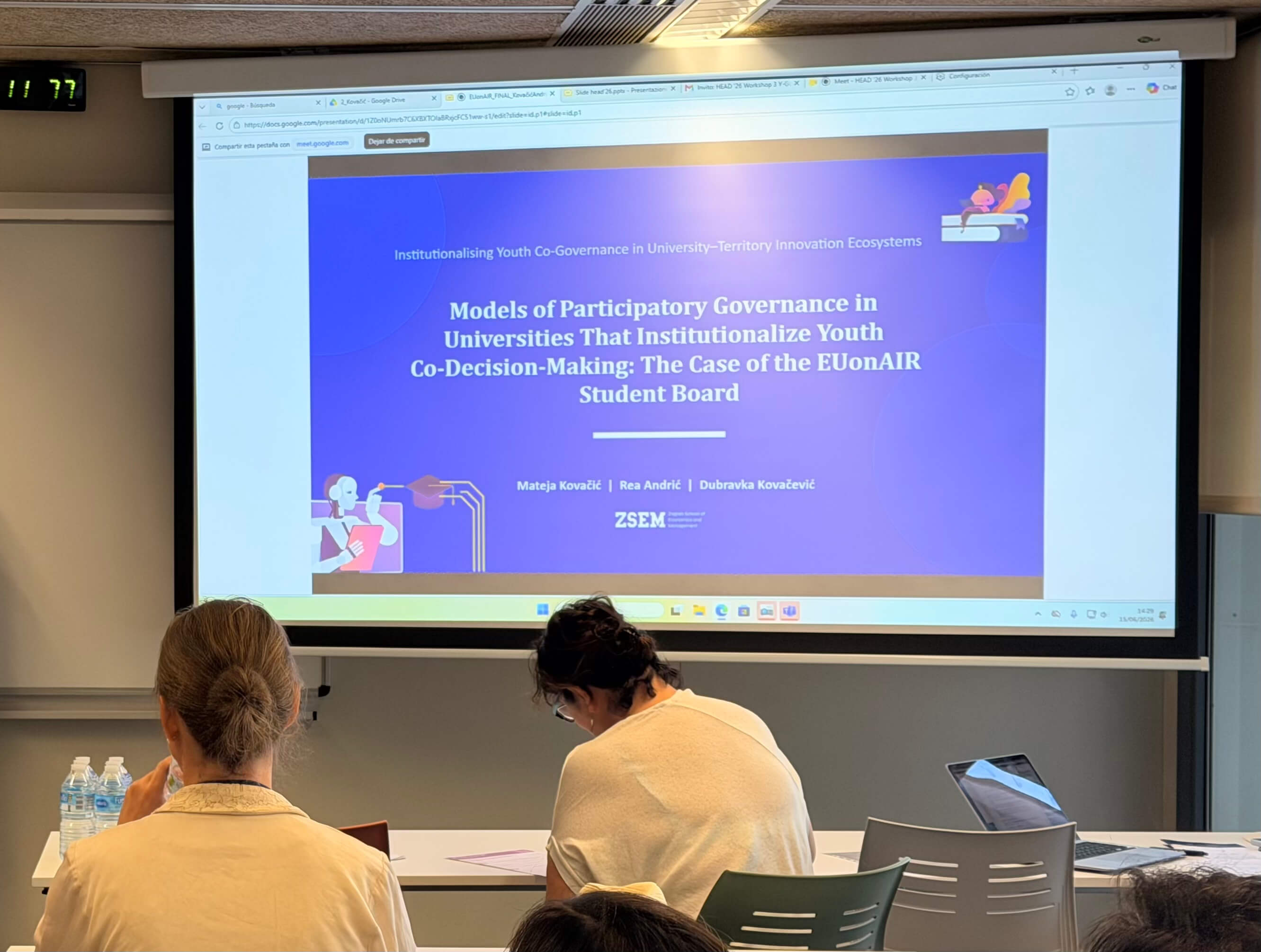
What does it take for student participation in university governance to move beyond symbolic representation toward genuine co-decision-making? This question brought Mateja Kovačić and Rea Andrić, WP3 team members from the Zagreb School of Economics and Management (ZSEM), to present their research at the HEAd'26 workshop held on June 15, 2026, at Universitat Politècnica de València, Valencia.
The workshop was organized by Prof. Stefania Capogna, Link Campus University in Rome, an EUonAIR associated partner. At the event, Mateja Kovačić and Rea Andrić presented the paper "Models of Participatory Governance in Universities That Institutionalize Youth Co-Decision-Making: The Case of the EUonAIR Student Board" co-authored by Dr. Dubravka Kovačević, WP3 Lead and Associate Dean for Project Initiatives and Development at ZSEM.
Using institutional analysis, the paper examines how the EUonAIR Student Board operationalizes youth co-decision-making across three dimensions: the formal governance framework, student agency in practice, and informal governance practices. The findings suggest that effective co-decision-making depends on formal integration within governance structures, clearly defined rotation protocols, and a dual-track model combining formal decision-making with high-frequency informal coordination. This research was supported by the EUonAIR, within the framework of the EUonAIR Centre of Excellence in Responsible AI in Education.
We are proud to see EUonAIR's approach to participatory governance contributing to the international academic conversation on meaningful student participation in higher education.